




You will not be allowed to compare more than 4 products at a time

Collection: Ettukol Pure Kanchipuram Silk Sarees
A curated selection of handwoven pure silk sarees representing the pinnacle of Kanchipuram weaving skill. Ettukol uses an eight-shuttle arrangement allowing multiple silk threads to interact at different levels within the same fabric pick, creating layered depth and dimensionality that no other Kanchipuram weave can produce. Every piece is Silk Mark certified and sourced directly from artisan weaver families. Free shipping across the USA.
Explore related Kanchipuram weave traditions: Korvai Kanchipuram sarees for interlocked contrast borders, Zari Kattam Kanchipuram sarees for a luminous gold grid body, Vairaoosi Kanchipuram sarees for needle-fine directional zari, and Rettapet Kanchipuram sarees for twin parallel borders.
Showing 1-3 of 3 Results
-
Vendor:Idam Living
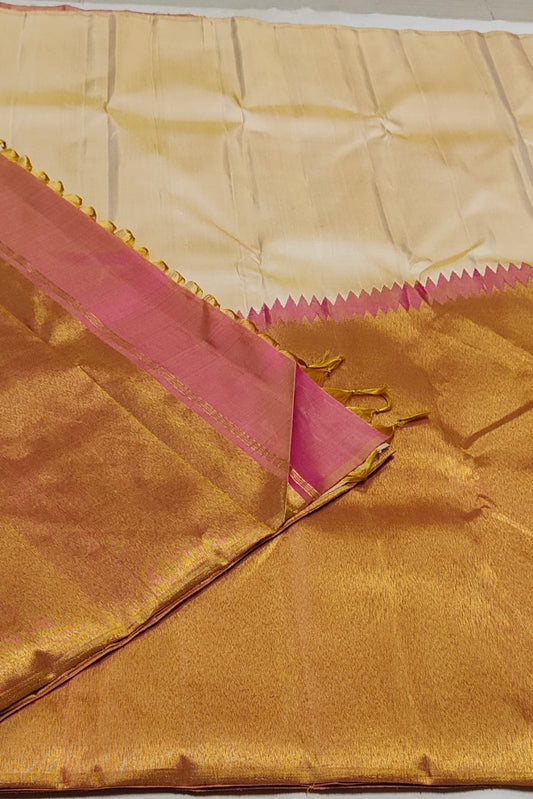
Warm Ivory Handwoven Pure Silk Kanjivaram Ettukol Saree with Rani Pink Temple Edge and Grand Antique Gold Zari Border
Regular price $299.00Sale price $299.00 Regular priceUnit price perSold Out -
Vendor:Idam Living
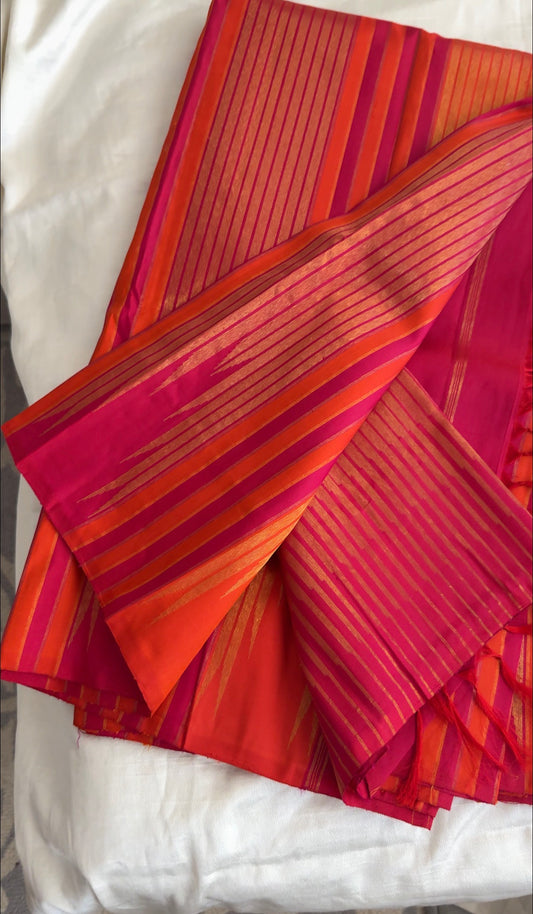
Pink Sunset Orange Handwoven Pure Silk Kanjivaram Ettukol Saree with Traditional Contrast Weave and Antique Gold Zari
Regular price $299.00Sale price $299.00 Regular priceUnit price per -
Vendor:Idam Living
Venpattu Ivory Pure Silk Kanchipuram Ettukol Saree with Multicolour Temple Border
Regular price $319.00Sale price $319.00 Regular priceUnit price per

Frequently Asked Questions
What is Ettukol in a Kanchipuram silk saree?
Ettukol — from the Tamil ettu meaning eight and kol meaning shuttle — is the most technically demanding weave structure in the entire Kanchipuram tradition. Where a standard Kanchipuram saree is woven with two to four shuttles, an Ettukol Kanjivaram requires the weaver to manage eight shuttles simultaneously at the loom — each one carrying a different silk or zari thread, each one contributing a distinct layer to the fabric structure. The simultaneous interaction of eight threads creates a body of extraordinary layered depth and three-dimensional texture that no other Kanchipuram weave can replicate. Ettukol is also referred to as Ettukol Kanjivaram, eight shuttle Kanjeevaram, and layered weave Kancheepuram across different Indian communities in the USA. It is one of the rarest Kanchipuram weaves in production today — the number of weavers who have mastered the eight-shuttle technique is a fraction of those who produce Korvai, Zari Kattam, or Vairaoosi.
What does it take to master the eight-shuttle Ettukol technique — and why do so few weavers achieve it?
In standard Kanchipuram weaving, a single weaver manages two to four shuttles in sequence — the shuttle passes are planned and the weaver develops muscle memory for the sequence over time. In Ettukol weaving, the same weaver must manage eight shuttles simultaneously — holding the complete eight-shuttle sequence in mind across every weft pass for the full six-metre length of the saree. Each shuttle carries a different thread at a different tension. Each pass requires a different shuttle in a specific sequence. A single error — the wrong shuttle, the wrong tension, the wrong sequence — creates a structural inconsistency in the fabric that cannot be corrected after the fact. The difficulty is not just physical but cognitive: the Ettukol weaver must hold an eight-variable sequence in active working memory across thousands of passes without a single deviation. This is why Ettukol takes years longer to master than any other Kanchipuram weave, why fewer weavers produce it, and why a genuine Ettukol Kanjivaram takes significantly longer to complete than any other piece of comparable size.
Why does an Ettukol Kanchipuram body appear three-dimensional — and what creates that depth?
The surface of a genuine Ettukol Kanjeevaram is unlike any other Kanchipuram weave because it has depth within itself. Where a Zari Kattam body has a flat geometric grid, a Vairaoosi body has a directional shimmer, and a Korvai body has a clean colour boundary, an Ettukol body appears to have layers — different thread interactions visible at different depths within the fabric, the surface shifting and changing as the light angle and viewing angle change. This three-dimensional quality is the direct result of eight different threads interacting at different depths within the same section of fabric. From across a room, an Ettukol Kancheepuram reads as extraordinarily rich and complex without being immediately legible — the surface has a quality of depth and movement that draws the eye in rather than presenting itself immediately. Under natural light and in motion, a genuine Ettukol Kanjivaram is the most visually complex surface in the Kanchipuram vocabulary.
What physical test distinguishes a genuine Ettukol Kanjivaram from a saree that merely looks complex?
The clearest identifier of a genuine Ettukol body is the quality of depth in the fabric surface — a characteristic that requires hands-on examination rather than photography. Hold the saree in natural light and look at the body from different angles. If the surface has a three-dimensional quality — if it appears to shift, layer, and change as the light and viewing angle change — you are looking at a genuine Ettukol weave. A flat, uniform surface, however beautiful, is not Ettukol. On close examination, multiple thread interactions should be visible within the same section of fabric — different threads at different depths creating the layered effect that is the signature of the eight-shuttle technique. On the reverse side, the full complexity of eight thread interactions should be visible — the back of the fabric as structurally complex as the front. A simplified reverse suggests fewer shuttles were used. The Silk Mark certification label is the final guarantee — every genuine Ettukol Kanjivaram at Idam Living carries Silk Mark certification from the Central Silk Board of India.
Why does Ettukol sit above every other Kanchipuram weave in the occasion hierarchy?
Ettukol occupies the highest occasion register in the Kanchipuram weaving vocabulary — above Korvai, above Zari Kattam, above Vairaoosi. This is not an everyday saree, not a festive daytime saree, and not a standard wedding guest saree. Ettukol is for the occasions that mark a lifetime — bridal muhurtham ceremonies, temple consecrations, major religious festivals of the highest ceremonial significance, and the milestone family occasions that happen once in a generation. For the South Indian diaspora in the USA, an Ettukol Kanjeevaram is the saree a mother wears at her daughter's wedding when she wants the most significant Kanchipuram statement possible. It is the saree chosen for a Brahmotsavam, a temple inauguration, or a family occasion of the highest ceremonial weight. No other Kanchipuram weave carries the same concentrated expression of the tradition's technical mastery and ceremonial authority in a single piece.
Why is Ettukol considered a collector and heirloom Kanchipuram saree?
Because a genuine Ettukol Kanjivaram is made in smaller quantities, by fewer weavers, over a longer production time than any other piece in the Kanchipuram vocabulary — and the fabric it produces is structurally more complex and more durable than any other Kanchipuram weave. The eight-thread layered structure of an Ettukol body gives the fabric an exceptional resilience — the multiple thread interactions distributing the physical stress of wearing and storing across a far greater number of structural elements than a two or four shuttle weave. An Ettukol Kancheepuram bought today, cared for correctly, will be worn at your daughter's muhurtham and your granddaughter's arangetram — the structural integrity of the eight-thread weave guarantees it. It is also genuinely rare: as the number of weavers who master the eight-shuttle technique declines, the availability of genuine Ettukol Kanjivaram pieces in the market decreases. A genuine Ettukol saree from a known weaver source is already a collector piece. In twenty years it will be more so.
Why is the Ettukol label the most misrepresented in the Kanchipuram market — and how does Idam Living guarantee authenticity?
Because the rarity of genuine Ettukol production makes the sourcing chain more susceptible to misrepresentation than any other Kanchipuram weave. A saree labelled Ettukol by a seller who cannot name the weaver family, the village, or the production method is not necessarily genuine Ettukol — the label can be applied to any textured or complex-looking Kanchipuram body weave. At Idam Living, our founder Anula Naidu's maternal grandfather's family are generational weavers from Kunnam village, Kanchipuram — our direct connection to the weaver families means we source Ettukol Kanjeevaram pieces with full traceability from the loom. Every Ettukol Kancheepuram at Idam Living is Silk Mark certified by the Central Silk Board of India, falls and pico finished, packed in a pure cotton storage bag, and ships free to all 50 US states from New Jersey. When you buy an Ettukol saree from Idam Living, you know exactly what you are buying — because we know exactly who made it.
How do I store an Ettukol Kanchipuram saree to preserve the three-dimensional surface depth long-term?
The eight-thread layered structure of an Ettukol Kanjivaram is, paradoxically, both the most complex and the most durable structure in the Kanchipuram weaving vocabulary — the multiple thread interactions distributing physical stress more widely than any simpler weave. The care requirements are the same as for any pure silk Kanchipuram: dry clean only, store in the pure cotton storage bag that comes with every Idam Living saree — cotton breathes naturally, maintains the silk and zari lustre, and keeps the fabric fresh across decades of storage. One specific consideration for Ettukol: because the body surface has layered depth from multiple thread interactions, avoid storing with anything pressing against the body surface for extended periods — sustained pressure against the layered threads can gradually flatten the three-dimensional texture that gives Ettukol its distinctive character. Store flat or loosely folded, never compressed under weight. Keep away from direct sunlight and perfume. Refold along different lines every few months. An Ettukol Kancheepuram cared for this way will hold its layered depth and surface complexity for as long as the silk itself lasts — which, in pure mulberry silk, is measured in generations not years.